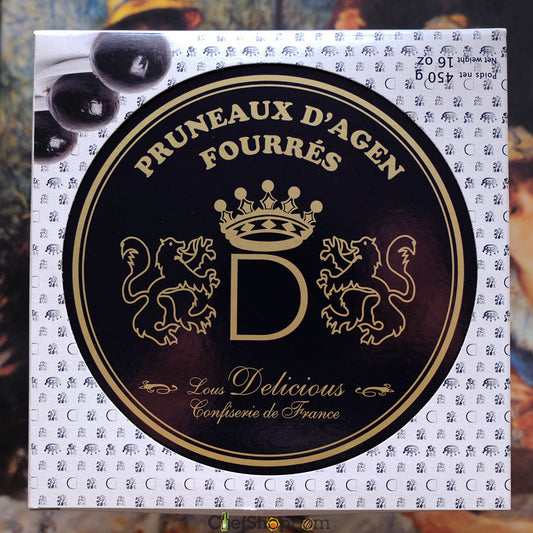
Pruneaux d’Agen (Agen prunes) are the famous dried plums of southwest France, especially from the Lot-et-Garonne region.
As the story is told the Crusaders returning from the Holy Land in the 12th century. Legend says they brought back the Damas plum variety from Syria. Then the Monks of the Benedictine abbey of Clairac grafted this exotic plum onto local rootstock, creating the Prune d’Ente (“grafting plum”), the variety that is still grown today.
The Southwest of France, the Lot-et-Garonne region, is filled with warm summers, soil rich in alluvium, and the air is filled with humidity from the Garonne River valley. These are perfect for plum orchards. By the Middle Ages, prunes in the region became a significant crop.
Agen, located on the pilgrimage route to Santiago de Compostela, became the main trading and export center for prunes. That’s why they’re called “Pruneaux d’Agen”, even though they’re grown across the region.
Traditionally, plums were dried in the communal four banal ovens before the development of specialized prune-drying kilns. This drying process allowed long-term preservation, making the prunes highly valued as provisions for travelers, merchants, pilgrims, and sailors.
They were shipped down the Garonne to Bordeaux and from there exported across Europe, where by the 17th and 18th centuries Pruneaux d’Agen had achieved widespread fame.
In 2002, the product received a Protected Geographical Indication (PGI), formally recognizing its historic link to the region and guaranteeing authentic production standards. Only Prune d’Ente plums grown, dried, and processed within designated areas of southwest France may bear the name “Pruneaux d’Agen.”
Today they are prized for their deep flavor, soft and sticky texture, natural sweetness, and nutritional richness, and they remain a beloved ingredient in both sweet and savory dishes—or simply enjoyed on their own. And they are rich in sugars, fiber, and nutrients!

 Click Email Me when in Stock
 Click Email Me when in Stock
 Click Email Me when in Stock
 Click Email Me when in Stock
 Click Email Me when in Stock


